.png)

How to Build a Real Estate Sales Pipeline in Salesforce That Never Drops a Deal
Real estate deals are often lost due to poor follow-ups and inefficient systems. This blog explores how a customized Salesforce pipeline with AI scoring, workflow automation, and real-time dashboards helps brokerages improve conversions and maximize revenue.
You had a hot lead last Tuesday. A buyer, pre-approved and motivated. Your agent logged the inquiry, sent a follow-up email, and then nothing. The lead slipped between the cracks, and three weeks later, that buyer closed with a competitor.
In the real estate industry, where a single deal can be worth hundreds of thousands of dollars, losing track of even one prospect is a costly mistake. Most brokerages and property firms are still relying on spreadsheets, sticky notes, or generic CRM setups that were never designed for the fast-paced, multi-stage nature of property sales.
The solution is a properly configured Salesforce for Real estate, one designed around how real estate actually works, not how a SaaS company sells subscriptions.
This guide walks you through exactly how to build that pipeline, step by step. What is Agentforce for Nonprofits?
Agentforce for Nonprofits is an autonomous AI platform within Salesforce that uses "reasoning" to handle multi-step workflows such as donor acknowledgments, beneficiary intake, and grant reporting without requiring manual human intervention for every step.
Agentforce for Nonprofits provides autonomous AI agents that proactively manage mission-critical operations. Unlike traditional automation, these capabilities leverage Salesforce Data Cloud to "reason" through complex tasks using your organization’s specific donor and program data.
Why Real Estate Deals Drop
The problem is rarely effort; it is a failure of systems. Real estate agents are not lazy they are overwhelmed by structural inefficiencies. Understanding these root causes is vital, as the financial drain of pipeline mismanagement is often staggering once calculated.
The Root Causes: Why Deals Are Lost
Several structural factors cause high-value opportunities to stagnate and vanish:
Lack of Uniform Pipeline Phases: Without standardized Salesforce Opportunity stages, communication collapses. Subjective terms like "warm" render data unreliable and meaningless.
Blurring Leads and Opportunities: Skipping the formal Lead-to-Opportunity conversion process buries qualified buyers under cold inquiries.
Manual Tracking Dependency: Systems fail when managers must rely on verbal updates. Without automated dashboards, high-value deals inevitably stagnate.
Generic Data Architecture: Default CRM setups lack real estate-specific fields (e.g., property type), forcing agents into inefficient "shadow spreadsheets."
Business Impact: The Price of Inefficiency
The consequences are both financial and operational. For a brokerage handling 200 leads monthly, a 10% leakage represents 20 lost opportunities. At an average $8,000 commission, the annual revenue loss exceeds $1.9 million.
Beyond revenue, operational costs mount through:
Duplicate Work: Lack of transparency leads to agents pursuing the same leads.
Wasted Time: Hours are lost to manual updates that should be automated.
Client Dissatisfaction: Neglected buyers or sellers rarely return.
In an industry built on referrals, a single bad experience can cost far more than one deal—it can jeopardize a brokerage's entire reputation.
Step-by-Step Solution: Building Your Real Estate Sales Pipeline in Salesforce
Define Your Pipeline Stages
Standardize your sales journey: Inquiry > Qualification > Showing > Offer > Under Contract > Due Diligence > Closed. Assign probability percentages to each stage to ensure weighted pipeline reports reflect actual revenue likelihood.
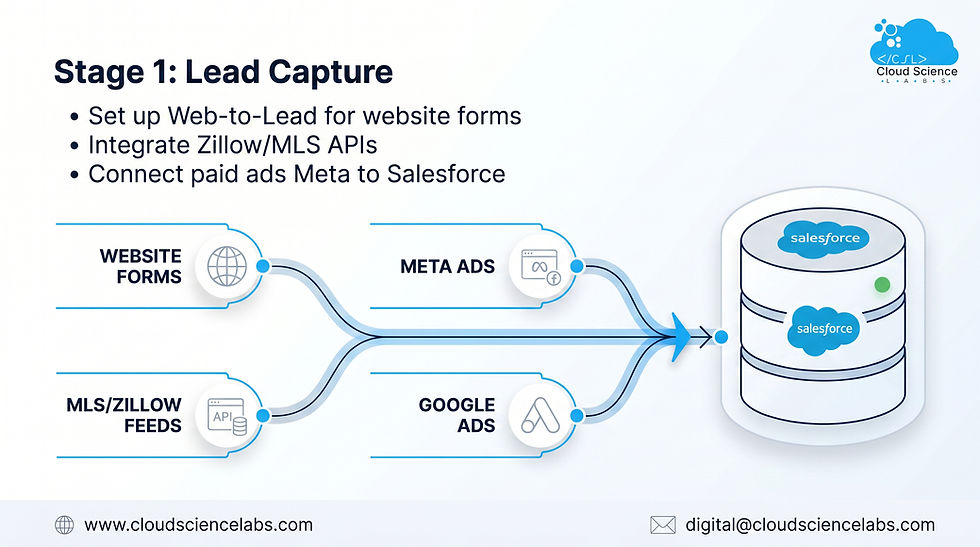
Establish a multi-source lead funnel by configuring Web-to-Lead forms and integrating Zillow/MLS APIs and paid ads (Meta/Google) directly into Salesforce.
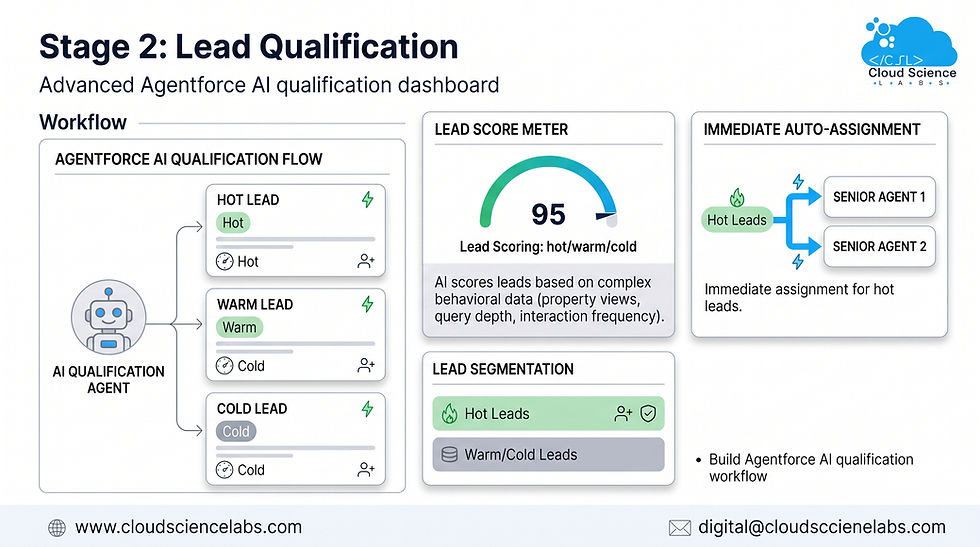
Use Agentforce AI to build qualification workflows that score leads (hot/warm/cold) based on engagement and auto-assign high-priority prospects to senior agents immediately.
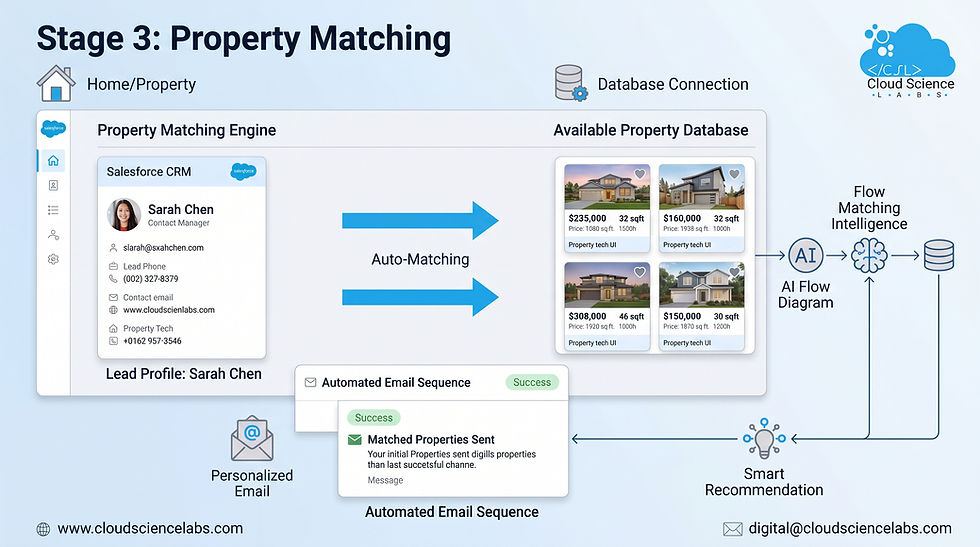
Connect your property database to enable auto-matching based on lead criteria and trigger personalized property emails automatically when new matches are found.
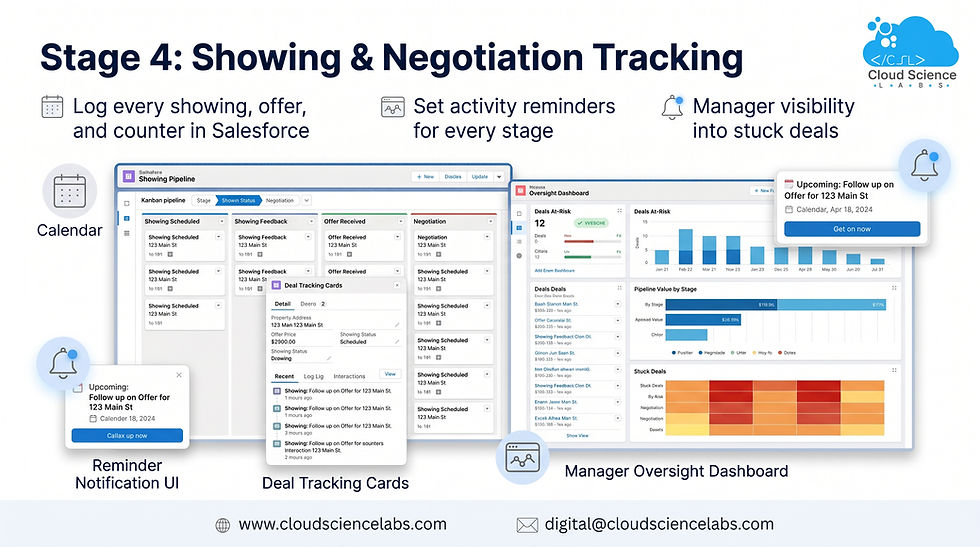
Use a Kanban board to track showings, offers, and negotiations. Set activity reminders for every stage to provide managers with instant visibility into any stalled deals.
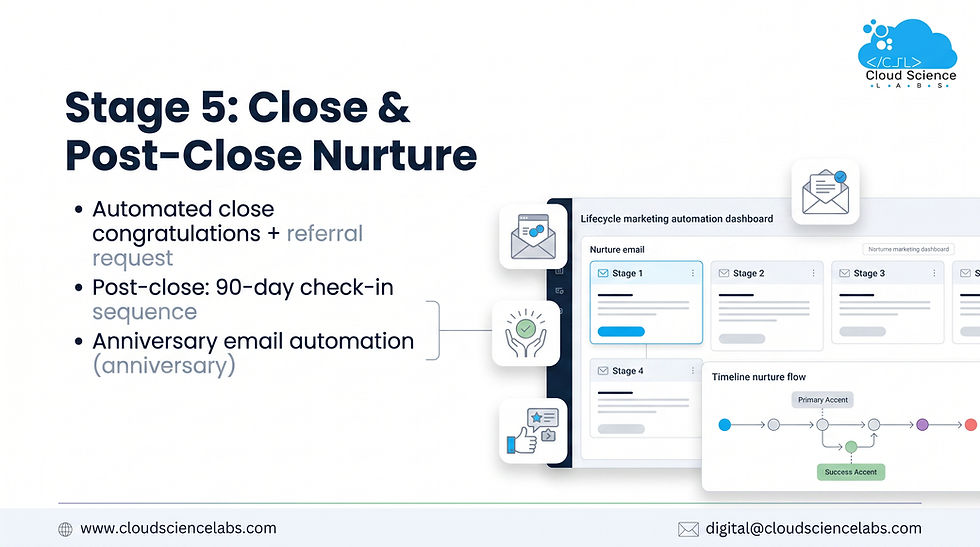
Automate post-close relationships to drive referrals, including "congratulations" emails, 90-day check-in sequences, and property anniversary reminders.
Real Example: How Cloud Science Labs Solved This for a Property Portal
The Challenge
A mobile property portal for homeowners and tenants faced growth constraints due to limited system customization and inefficient lead-to-opportunity conversion workflows.
The Solution
Cloud Science Labs implemented a customized Salesforce Real Estate CRM solution, focusing on system compatibility, data integrity during conversion, and a user experience optimized for agents rather than administrators.
Key Features:
Custom Real Estate Workflows: Tailored conversion processes built for specific business requirements.
Efficient Field Updates: Update multiple fields simultaneously during conversion, reducing redundant data entry.
Tech Stack Integration: Seamless connectivity with existing systems for a unified ecosystem.
Intuitive UI: A user-centric interface designed for easy navigation and high adoption.
Significant Outcomes:
Pipeline Accuracy: Achieved consistent, reliable data across all stages.
Smoother Conversions: A streamlined process that saves time and reduces friction.
Operational Alignment: A Salesforce environment mirroring real-world real estate tasks rather than a generic template.
Deal Retention: Better prospect tracking from inquiry to close to eliminate process gaps.
Read the full success story here : Salesforce Implementation for Lead-to-Opportunity Feature for the Real Estate Industry
Recommendation
If your team is losing deals due to poor follow-up or lack of visibility, you need better infrastructure. A custom Salesforce pipeline brings consistency and accountability to the deal cycle.
Start by auditing your current Opportunity stages to identify where deals stall. For expert help with custom real estate workflows and dashboards, contact Cloud Science Labs. Close the gaps in your process before more deals fall through.
Do not let another deal fall through a gap you could have closed weeks ago.
Frequently Asked Questions
1. What is a real estate sales pipeline in Salesforce?
It is a structured sequence of Opportunity stages that tracks deals from initial inquiry to closing, providing a shared view of all transactions and required actions.
2. How do I set up Salesforce Opportunity stages for real estate?
Navigate to Setup > Object Manager > Opportunity > Fields & Relationships > Stage. Edit the picklist to match your sales process and assign probability percentages for forecasting.
3. What Salesforce custom fields should a real estate firm add?
Add fields for property address, type, bedrooms, price (asking/offer), budget, and financing. Map these between Lead and Opportunity objects for seamless conversion.
4. Is the Kanban view useful for real estate teams?
Yes. It provides a visual board where agents can drag and drop deal cards through stages, offering an instant overview of the entire pipeline without running reports.
5. How do Salesforce dashboards and reports help brokerages?
They provide real-time visibility into pipeline value, agent performance, and lead ROI, replacing manual reporting with automated, data-driven insights.



The point about a hot, pre-approved buyer going silent really shows why automated follow-ups and AI lead scoring matter. Real-time dashboards could make pipeline gaps much easier to catch. I’ve been using https://byteplusai.site/models/seedance-alternative
AI scoring and automated follow-ups seem especially useful for preventing hot, pre-approved buyers from slipping through the cracks. Real-time dashboards should make pipeline gaps much easier to spot. I've been using https://fashn.pro