.png)

How Agentic AI is Redefining Business Operations?
Updated: Aug 8, 2025
Business operations are changing fast, and AI is right at the center of this change. One of the most exciting developments today is something called Agentic AI, which is taking automation to the next level.
Unlike traditional AI, which executes tasks based on fixed rules, Agentic AI for business operations can plan, make decisions, and take actions on its own. It is like having a digital team member who understands your goals and works towards them, just like a human would.

In this blog, we will explore what Agent AI means, how Salesforce is applying Agentic AI for business operations across its platforms, what makes it different, and why it’s not just a futuristic idea but something that’s already making a real impact. We will also see how we at Cloud Science Labs are helping businesses use this powerful technology to work smarter, faster, and better.
What Is Agentic AI and Why Does It Matter
At a basic level, Artificial Intelligence (AI) is entering a new era that is rapidly evolving, moving beyond reactive systems to those capable of proactive and autonomous action. This evolution, known as Agent or Agentic AI, is poised to power up and redefine business operations, driving intelligent automation at an unprecedented scale.
How Is Agentic AI Different from Traditional Automation?
It works on its own: You don’t have to guide it through every step.
It understands its environment: It pulls information from systems like CRMs, calendars, databases, and more.
It makes decisions based on goals and the situation at hand.
It takes action: From sending emails to updating records and scheduling follow-ups, it takes action.
It learns and improves: The more it works, the better it gets.
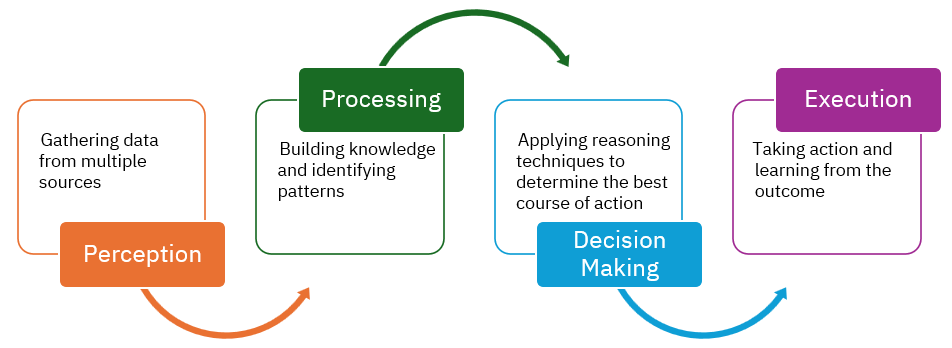
This represents a big step up from basic automation, where you have to map out every single step in advance. Intelligent agents work differently and can spot problems on their own and figure out how to fix them. It takes in data from different sources, makes sense of it, and then uses that knowledge to plan and take action. What sets it apart is its ability to keep learning and adapting, like a smart assistant that gets better with every task.
What Does a Real-World Agentic AI Example Look Like?
Here’s a simple example:
Let’s say there’s an overdue invoice.
A normal system would just remind you.
Salesforce’s intelligent automation, on the other hand, can:
Reach out to the customer
Suggest a new payment date
Update the CRM
Schedule a reminder
All without anyone doing anything.
What Are Experts Saying About Agentic AI?
There are some top Industrial Leaders who defined Agent AI in Human-Centered Intelligence.
“We’re defining AI Agents as systems that can plan autonomously and take actions to meet goals.” – Tom Coshow, Gartner.
“Agents are proactive. They learn, recognize patterns, and offer help before you ask.”- Bill Gates.
“AI has the power to act on its own to achieve a goal. Humans set the goals; agents figure out how to get there.” - Deloitte TMT Predictions 2025
How is Salesforce Using Agentic AI Across Its Platform?
Salesforce is building smart AI systems into its platforms to help businesses be more efficient, responsive, and intelligent. The goal isn’t to replace people, it’s to remove repetitive tasks and help teams focus on higher-value work. Across industries like sales, service, marketing, and operations, Salesforce is enabling business leaders and big tech firms to deploy AI agents in the customer support services that learn, act, and respond with context. This is helping businesses deliver faster and more personalized experiences.
How Salesforce is Using Agent AI
1. Einstein: The Foundation of Salesforce AI Agents
Salesforce’s Einstein is the foundation of Salesforce AgentForce, but now it’s being enhanced with agentic capabilities. That means it can:
Understand natural language using LLMs (Large Language Models)
Learn from trial and error (Reinforcement Learning)
Manage tasks that span multiple systems and steps (Autonomous Workflows)
2. How It All Fits Together: The Technology Stack
Think of the architecture like this:
Data Sources – From CRM, ERP, or IoT systems
Einstein AI Core – Where all the smart analysis happens
Agent Orchestration – Plans and prioritizes tasks
Action Layer – Executes the steps in Salesforce and other platforms.

How Are Businesses Using Salesforce Agentic AI Today?
Here is a real-life example of how businesses are already using AI Agent implementation with Salesforce:
1. Customer Service
Automatically respond to common support questions.
Predict when a product will fail and trigger service before the customer complains.
Customize communication based on a customer’s history and preferences.
2. Sales
Scan leads and suggest the best ones to follow up with.
Write personalized emails or schedule meetings based on prospect behavior.
Help sales reps by recommending the next steps in the deal process.
Helps improve sales agent performance with AI and maximizes sales by acting as a smart assistant throughout the sales cycle.
3. Marketing
Watch campaign performance and adjust targeting automatically.
Generate content that fits each audience.
Design and run journeys that change based on customer actions.
4. Operations
Handle internal workflows like approvals or compliance checks.
Monitor supply chains and reorder items when needed.
Answer employee questions or walk them through processes.
Case Study: How a Cleaning Services Company Transformed with AgentForce
Here is a real case study from Cloud Science Labs helping a cleaning services company run a smarter and faster business with Agentic AI implementation:
Challenges:
A fast-growing cleaning services company came to us with a challenge. This client offered on-demand cleaning services, from industrial deep cleaning to hospital sanitation. But they were stuck with slow bookings, staff double-booking, and an impersonal customer experience. Their team was confused:
The booking process was slow
The support team was overwhelmed
Customers felt frustrated
Agents were being double-booked
Systems were not integrated
When you're running a service business that depends on speed, trust, and flexibility, like deep cleaning or floor maintenance, you can't afford to keep customers waiting.
They knew they needed to move faster and connect better with clients, especially as their business grew, and we had the answer.
Our Solution: AgentForce
We built a customized smart AI assistant using Salesforce AgentForce, our intelligent AI agent that talks to customers, handles bookings, sends updates, learns, and solves problems just like a smart team member would.
Our Key Solutions Features Were:
24/7 AI Chat Agent
Real-Time Availability Sync with Agent Schedules
Multichannel Support: Website, WhatsApp, Facebook Messenger
Remembers past interactions for better conversations
Easy Escalation to Human Support When Needed
Sends confirmations, invoices, and reminders instantly
Here’s how it was done:

The Technology Used to Build This Solution Was:
Salesforce Service Cloud – to manage customer records and service feedback.
Chatbot Embedded Service Deployment – for the chat interface to customers for the requirement, and comes with better results with accuracy.
AgentForce AI Layer – trained to understand customer needs and take action.
Prompt Template from Salesforce Data Cloud – to read the memory of past interactions.
The Results:
Faster booking confirmations to 85%
Increase in customer satisfaction to 40%
Better field agent utilization, more than 30%
The rise in average revenue per booking was above 22%
Increase in after-hours engagement to 50%
Comparison Table: Agentic AI vs. Traditional Chatbots
Here’s what makes AgentForce smarter than traditional chatbots
Feature | Traditional Bot | AgentForce AI Agent |
Scripted Responses | Yes | No (understands context) |
Real-Time Scheduling | No | Yes |
Human-Like Empathy | No | Yes |
Learning Over Time | No | Yes |
Multichannel Support | Limited | Full |
Escalation with Context | No | Yes |
Conclusion:
With Salesforce Intelligent Agents, the transformation isn’t just technical but emotional. Your customers feel heard, teams feel empowered, and the business grows stronger. That’s the real magic of smart AI systems.
As industries grow more complex and customer expectations continue to rise, your business needs to adopt an intelligent and autonomous AI system that gives you a competitive edge. Choose Salesforce AI to stay ahead by working smart, and now is the time to do it!
Want to Bring This to Your Business?
Whether you’re in services, logistics, healthcare, or hospitality, AgentForce can make your operations faster, smarter, and more human. At Cloud Science Labs, we specialize in Agentic AI implementation, development, and customization tailored to your business workflows across industries.
Let’s build your intelligent digital workforce. Get in touch with us today!
Email us at digital@cloudsciencelabs.com
FAQs:
1. What exactly is Agentic AI, and how is Salesforce using it in business operations?What exactly is Agentic AI, and how is Salesforce using it in business operations?
AI Agent refers to smart, autonomous agents that can perceive their environment, make decisions, and act independently to achieve specific goals. Salesforce uses it to create digital agents like AgentForce that talk to customers, handle bookings, and support internal tasks without human input.
Regular bots follow fixed rules. AI Agent takes things further by using real-time context, learning patterns, and goal-based reasoning to make decisions. It doesn’t just follow instructions, it figures out what needs to be done and does it, intelligently and autonomously.
3. What types of businesses benefit most from Salesforce Agentic AI?
Industries like healthcare, logistics, field services, hospitality, and cleaning services benefit significantly. Any business that requires fast scheduling, responsive communication, or high customer interaction can use a smart AI agent to speed things up and deliver a more personalized experience.
4. Is Agentic AI secure and compliant with industry standards?
Yes. When built within Salesforce, Agent AI solutions follow strict enterprise security protocols, including compliance with GDPR, HIPAA, and other data privacy standards. Data is encrypted and securely handled according to Salesforce's best practices.
Not at all. AI Agent is designed to assist, not replace, human employees. It handles repetitive tasks, responds instantly, and works around the clock so that your human team can focus on higher-value, more complex work. Think of it as an intelligent digital coworker.
It depends on complexity. A simple AI assistant that handles chat and appointment booking could be live in 4 to 6 weeks. More advanced implementations that integrate with external APIs and business logic may take a few months with phased rollouts.
7. Can an AI Agent work with other tools outside of Salesforce?
Yes, these solutions can integrate with third-party tools like Google Calendar, WhatsApp, Slack, payment gateways, and more. It’s designed to act as a central brain that connects different systems and drives real-time actions based on business goals.


Great perspective on how agentic AI can transform business operations. Moving beyond predefined rules toward systems capable of contextual decision-making could significantly improve workflow automation: https://medium.com/lets-code-future/ai-agents-vs-traditional-automation-understanding-the-key-differences-71c7f9be8e