.png)

The ROI of Agentforce for Nonprofits: A Real-World Breakdown
Agentforce for Nonprofits delivers ROI by automating repetitive administrative tasks, recovering an average of 20+ staff hours per week, increasing beneficiary intake capacity by 35%, and improving donor retention through personalized, scalable communication.
What is Agentforce for Nonprofits?
Agentforce for Nonprofits is an autonomous AI platform within Salesforce that uses "reasoning" to handle multi-step workflows such as donor acknowledgments, beneficiary intake, and grant reporting without requiring manual human intervention for every step.
Agentforce for Nonprofits provides autonomous AI agents that proactively manage mission-critical operations. Unlike traditional automation, these capabilities leverage Salesforce Data Cloud to "reason" through complex tasks using your organization’s specific donor and program data.
How does Agentforce generate measurable ROI for nonprofits?
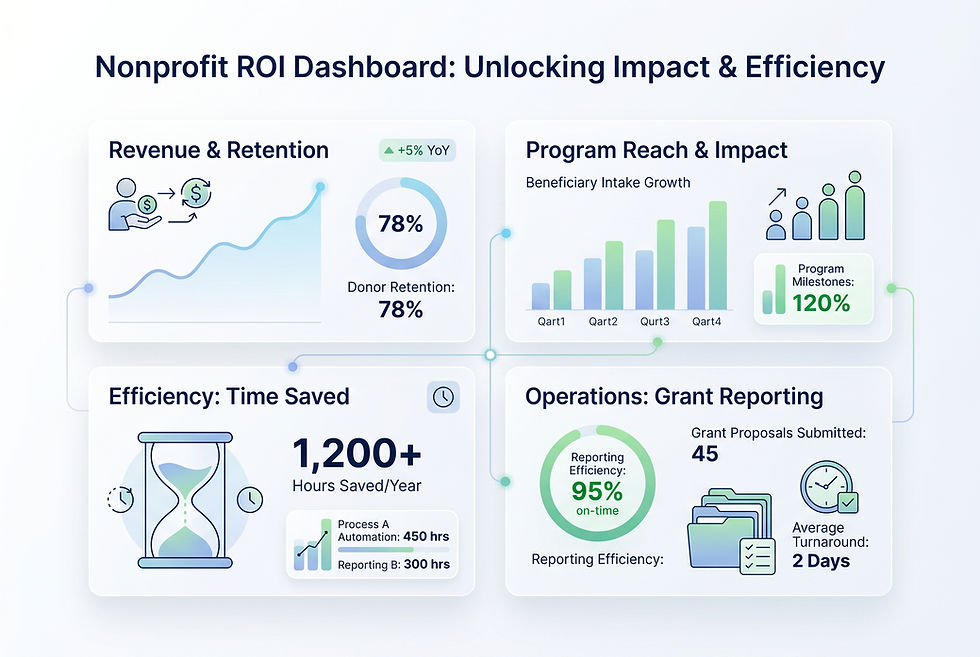
The ROI of Agentforce is categorized into four specific "Value Levers" that allow organizations to scale without increasing headcount:
ROI Category | Primary Impact | Data Metric to Track |
Staff Time Recovery | Automates manual routing and notifications. | Administrative hours saved per week. |
Donor Retention | Triggers personalized impact updates & thank-yous. | % Increase in second-gift conversion. |
Reporting Efficiency | Auto-aggregates data for grant submissions. | Reduction in days spent per report. |
Program Capacity | Speeds up beneficiary intake and screening. | % Increase in beneficiaries served. |
For nonprofits, the calculation is more layered.
Staff time is often volunteer or grant-funded. Saving ten hours per week per staff member matters enormously but translating that into a dollar figure requires understanding how that time was funded and what it displaces.
Outcomes are not always revenue. A nonprofit's primary goal might be beneficiary reach, programme completion rates, or donor retention none of which map cleanly to a standard revenue-per-lead formula.
Technology budgets are tight and scrutinised. An investment that takes 18 months to show returns may not survive the next funding cycle. Nonprofits need to see early, visible wins to sustain internal buy-in.
Despite these complexities, Agentforce for Nonprofits produces measurable ROI across operational cost, staff capacity, donor engagement, and programme delivery. The key is knowing where to look.
Where Nonprofits Lose Time and Money Without Automation ?
To understand the "Cost of Inaction," organizations should audit these four high-friction areas:
1. Manual Donor Acknowledgments In most nonprofits, donor acknowledgements, campaign updates, and renewal reminders are handled by a small team working from spreadsheets or basic CRM exports. Each communication cycle takes hours of staff time and produces inconsistent outreach.
2. Hand-Compiled Grant Reports
Grant reporting requires pulling data from multiple sources, reconciling records, and formatting outputs for each funder's requirements. This can consume two to three days per report per grant cycle.
3. Linear Beneficiary Intake
New programme applicants are often processed through manual intake flows received, reviewed, logged, and followed up individually. Staff capacity limits how many applications can be processed per week, directly capping programme reach.
4. Spreadsheet-Based Volunteer Coordination
Matching volunteers to programmes, sending schedules, managing cancellations, and tracking hours is time-intensive work that pulls staff away from direct service delivery.
How Agentforce for Nonprofits Generates Measurable ROI ?

ROI from Agentforce for Nonprofits falls into four categories.
1. Staff time recovery
The most immediate and quantifiable return. When Agentforce automates donor acknowledgements, intake routing, volunteer notifications, follow-up sequences, and Agentforce donor management, staff hours previously spent on those tasks are freed for programme delivery, relationship management, and strategic work.
2. Donor retention improvement
Agentforce for Nonprofits enables personalised, timely donor journeys at scale , thank-you sequences triggered within hours of a gift, impact updates tied to specific programmes a donor has funded, and renewal reminders calibrated to giving history. These are not mass emails. They are contextual, CRM-driven interactions that increase the likelihood a donor gives again.
3. Grant reporting efficiency
Agentforce can automate the data aggregation step of grant reporting , pulling programme metrics, beneficiary counts, and activity logs from Salesforce records and assembling them into structured report templates. What previously took two to three days per report cycle can be reduced to a review-and-submit process.
4. Programme capacity expansion
When intake workflows are automated applications acknowledged, eligibility pre-screened, and case files created without manual processing the number of beneficiaries a team can serve increases without adding headcount. This is perhaps the most mission-critical form of ROI for a nonprofit: more people reached with the same resources.
How Salesforce Non-Profit Cloud and a Custom Portal Streamlined Global Volunteer Operations
A global non-profit organization dedicated to shaping young leaders through impactful seminars, inspiring a network of over 500,000+ alumni to build confidence, develop leadership skills, and drive positive change in their communities.
The organization struggled with manual volunteer management and event registration processes, which hindered their ability to scale effectively. This approach led to:
Ineffective Interactions: Difficulty managing volunteer and event interactions, leading to stakeholder dissatisfaction and organizational delays.
Event Management Struggles: A lack of centralized tracking for event registrations, attendance, and performance, making it hard to measure impact.
Manual Tracking Errors: Slow and error-prone volunteer application tracking that reduced operational efficiency and strained resources.
Cloud Science Labs (CSL) implemented Salesforce Non-Profit Cloud (NPC) and developed a tailored portal to simplify volunteer registration and event oversight:
Custom Portal Development: A user-friendly, scratch-built portal designed to centralize volunteer application tracking and event management.
Multi-Role Registration & Approval: Enabling students to register for multiple volunteer roles simultaneously with a streamlined review and approval workflow.
Centralized Reporting & Insights: Integrated reporting features that provide real-time updates and data-driven insights on volunteer activity and participation.
By transitioning to an automated Salesforce ecosystem, the organization improved its operational efficiency by 40%. The modernized system allows for faster decision-making, better event management, and deeper engagement across its global alumni network.
Read the full story: Salesforce Implementation and Development of Non-Profit Portal
How Nonprofits Should Approach Agentforce ROI?

ROI means different things to a food bank, a housing charity, and an advocacy organisation. The framework has to match the operation.
Start here before any implementation conversation:
1 . Map your highest-volume repetitive workflows first.
Donor acknowledgement, beneficiary intake, volunteer coordination, and report data aggregation are the most common starting points. Quantify how many staff hours per week those workflows currently consume.
2. Define your baseline metrics now.
Choose a pilot workflow, not a full deployment. Implement Agentforce for Nonprofits on one workflow donor acknowledgement is usually the fastest to configure and the easiest to measure. Run it for 60 days and document the time recovered and the response rate improvement before expanding.
3. Bring your board into the ROI framing early.
Boards and grant committees are more receptive to technology investment when the case is built around mission capacity and operational efficiency not technology capability. Frame the pilot outcomes in terms of beneficiaries reached and staff hours freed for direct service.
4. Plan for change management.
Staff adoption is the most common reason automation pilots underdeliver. Build a simple internal communication plan that explains what Agentforce is doing, what it is not doing, and how staff roles will improve not be replaced.
Organisations that have worked through agentforce consulting services implementations find consistently that the financial ROI, while real, is secondary to the mission ROI the ability to serve more people, respond faster, and report more accurately without burning out a small, committed team.

The principle is always the same: start narrow, measure honestly, and scale what works.
CSL has supported similar implementations in nonprofit environments where operational complexity and limited budgets required a phased, evidence-led approach.
Ready to discuss your nonprofit's needs? Get in touch with Cloud Science Labs today.
Frequently Asked Questions
1. Is Agentforce affordable for small nonprofits with limited technology budgets?
Salesforce’s "Power of Us" program provides discounted licenses. Small organizations can further manage costs by starting with focused pilots rather than full enterprise deployments.
2. Do we need a dedicated Salesforce administrator to run Agentforce?
Not for daily use, but initial configuration and optimization require Salesforce expertise, either in-house or through a certified implementation partner.
3. How is Agentforce different from standard Salesforce automation tools like Flow?
While standard tools follow rigid rules, Agentforce uses contextual intelligence to manage multi-step conversations and make judgment-based decisions using real-time data.
4. Can Agentforce manage donor communication across multiple campaigns at the same time?
Yes. Agentforce manages personalized outreach across different donor segments in parallel, leveraging Salesforce data to automate communication without increasing staff workload.
5. What data does Agentforce need to start producing results?
Utility depends on data quality. At minimum, nonprofits need clean contact records and reliable activity history. A data audit is recommended before implementation.
6. How long before a nonprofit sees measurable ROI from Agentforce?
Time savings are usually visible within 30-45 days. A clear, documented return on investment is typically achieved within one full quarter of a correctly configured pilot.



Comments